Losing a tooth, whether due to injury, decay, or accident, can feel like a major setback. Beyond the immediate hit to your confidence and smile aesthetics, a missing tooth can also cause serious long-term issues, affecting your ability to chew and even causing the surrounding teeth to shift out of alignment. If you are exploring reliable, fixed solutions for filling that gap, you have likely heard the term mouth bridge.
A mouth bridge, commonly known simply as a dental bridge, is a popular, tried-and-true method for replacing one or more missing teeth. It’s designed to literally bridge the space created by the lost tooth, restoring both function and appearance. Since they are a fixed solution—meaning they are cemented into place and cannot be removed—they offer a level of stability and permanence that removable dentures cannot match. Understanding how a mouth bridge works is the first step toward getting your complete, healthy smile back.
While the technology for replacing teeth has advanced significantly, the traditional mouth bridge remains a vital treatment option. However, before committing to any procedure, it is crucial to understand all available alternatives, especially when comparing a mouth bridge to modern surgical options like implants.
Understanding the Traditional Dental Bridge
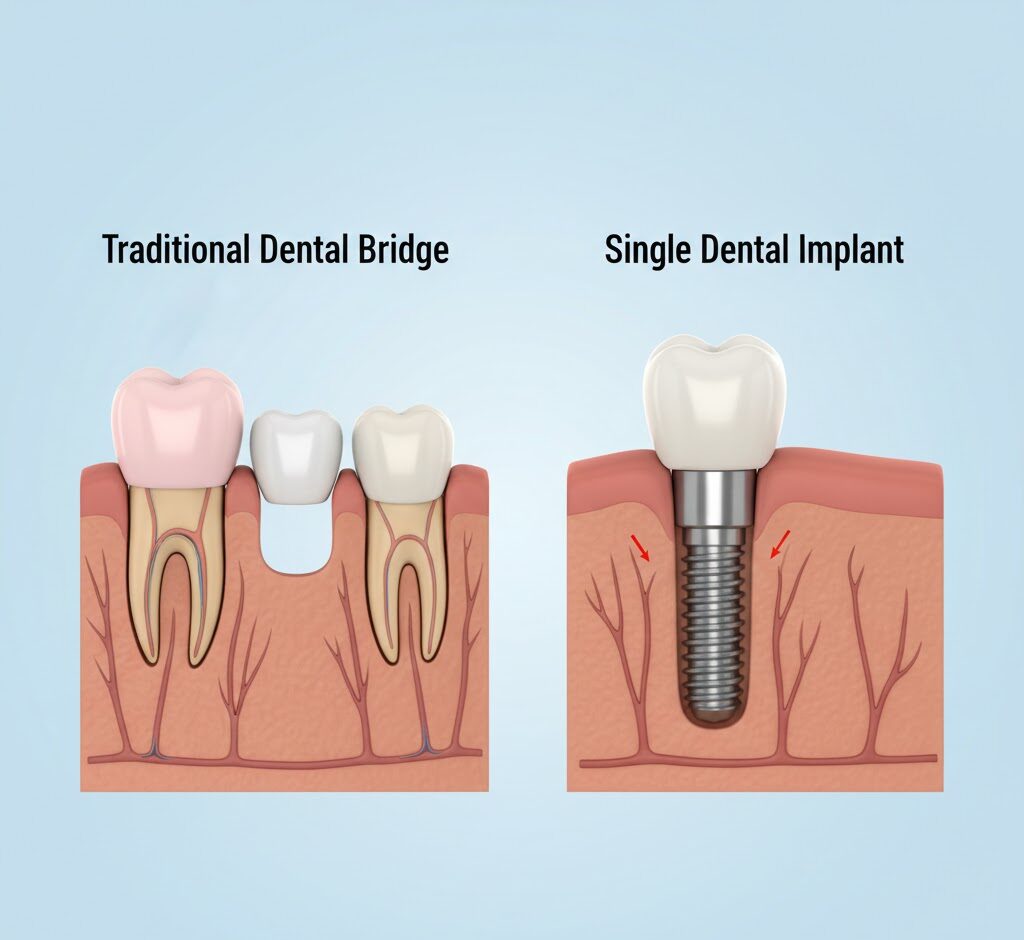
A dental bridge is a custom-made restoration consisting of at least three units: two crowns that fit over the natural teeth (called abutment teeth) surrounding the gap, and the replacement tooth (called a pontic) that rests in the empty space. Once the bridge is cemented into place, it offers a secure and natural-looking replacement.
For decades, the dental bridge has been a staple in restorative dentistry because it offers a relatively straightforward path to tooth replacement. The process typically requires two appointments. During the first visit, the supporting teeth on either side of the gap are prepared, meaning they are filed down slightly so that the bridge crowns can fit snugly over them. Impressions are then taken and sent to a lab where the final restoration is crafted. A temporary bridge is usually placed for comfort while you wait. During the second appointment, the final, permanent dental bridge is fitted and cemented into place.
Pros and Cons of Dental Bridges
The reasons many patients and dentists opt for a dental bridge are straightforward. They are typically less invasive than surgical options, the entire process is completed relatively quickly (often within a few weeks), and they are highly effective at restoring chewing and speaking ability. Furthermore, they prevent adjacent teeth from drifting into the empty space, which helps maintain the overall integrity of your bite.
However, a significant drawback is the preparation required on the adjacent teeth. If the teeth surrounding the gap are perfectly healthy and unrestored, preparing them for crowns means removing healthy enamel—a permanent alteration that increases the risk of those teeth needing treatment in the future. Bridges also require careful maintenance, as the area under the pontic needs special cleaning tools (like floss threaders) to prevent plaque buildup and potential decay in the abutment teeth.
Types of Dental Bridges
While the traditional bridge is the most common, dentistry offers a few variations depending on the patient’s needs:
Traditional Bridge: Best when there are strong natural teeth on both sides of the gap to act as anchors.
Cantilever Bridge: Used when there is only one natural tooth adjacent to the gap. This option is less common now, especially for molars, as the pressure can eventually damage the single supporting tooth.
Maryland Bonded Bridge: Uses a metal or porcelain framework bonded to the back surface of the adjacent teeth. This is more conservative because it requires less alteration to the adjacent teeth, making it a good choice for replacing front teeth where chewing forces are minimal.
Dental Bridge vs a Dental Implant: Which Solution Fits Your Smile?
When considering a fixed tooth replacement, the most important conversation you will have with your dentist revolves around a dental bridge vs a dental implant. While both restore your smile, they function entirely differently, impacting your long-term oral health.
The key difference lies in what they replace. A dental bridge replaces only the visible crown portion of the missing tooth, resting on top of the gums. A dental implant is a titanium screw surgically placed into the jawbone, replacing the root of the missing tooth. Once fused with the bone, the implant serves as a sturdy anchor for a custom crown.
Longevity and Bone Health
Implants generally offer greater longevity. A high-quality implant can last a lifetime with proper care, whereas a dental bridge typically needs replacement after 5 to 15 years, depending on hygiene and wear.
More critically, implants stimulate the jawbone, preventing the bone loss (resorption) that naturally occurs when a tooth root is removed. Because a bridge only sits on the gumline, it does nothing to preserve the bone structure underneath the missing tooth, leading to eventual recession and potentially altering facial structure over many years. For patients focused on preserving long-term bone volume, the dental implant is usually the superior choice.
Cost and Time Commitment
The initial investment for a dental implant is usually higher than for a dental bridge, and the total treatment time is longer—often taking several months to allow for the surgical site to heal and the implant to fully fuse with the bone (a process called osseointegration).
In contrast, a mouth bridge is completed faster and may be more easily covered by standard dental insurance plans, making it an excellent choice for patients who need immediate results or have budget limitations that prohibit the surgical expense of an implant.
Choosing between a dental bridge vs a dental implant involves weighing multiple factors: the health of your adjacent teeth, the density of your jawbone, your budget, and the time you are willing to commit to the procedure. If the adjacent teeth already have large fillings or need crowns, a dental bridge might be the most practical way to treat both issues simultaneously. If the adjacent teeth are pristine, an implant is often recommended to avoid damaging healthy enamel.
Ultimately, the goal is to find the restoration that provides the best function and aesthetics for your individual needs. By discussing your unique oral health profile and goals with your dental professional, you can determine whether a traditional mouth bridge or a modern implant provides the perfect foundation for a stable, beautiful smile.